PICKUP CAB STYLES
Mapping Notes:
Dodge Mega Cab is an Extended Crew Cab Pickup
Toyota “Access Cab” is an Extended Cab, “Double Cab” is a Crew Cab
Crew Cab: Double Cab, Dual Cab or Quad Cab
Extended Crew Cab: Mega Cab
Extended Cab: Access Cab, Super Cab, Club Cab or King Cab
Super Crew: Available only on the XLT and Lariat trim levels, the SuperCab body style can fit six passengers and is available with longer bed lengths. This style has four doors. The back two doors are rear-hinged for wide access to the back seat.
Pickup cab styles (from wikipedia)
Pickup trucks have been produced with a number of different configurations or body styles.
Standard cab
A standard cab pickup has a single row of seats and a single set of doors, one on each side. Most pickups have a front bench seat that can be used by three people, however within the last few decades, various manufacturers have begun to offer individual seats as standard equipment.
Extended cab
Extended or super cab pickups add an extra space behind the main seat. This is normally accessed by reclining the front bench back, but recent extended cab pickups have featured suicide doors on one or both sides for access. The original extended cab trucks used simple side-facing “jump seats” that could fold into the walls, but modern super cab trucks usually have a full bench in the back. Toyota offered a version of the Stout with two doors (one each side) and two full width bench seats to hold 6 people in 1954. Dodge introduced the Club Cab in 1973. Ford followed with the SuperCab concept on their 1974 F-100. In 1977 Datsun introduced the first minitruck with extended cab, their King Cab. GM, oddly enough, did not offer one on their full-size pickups until 1988. The S-Series(Chevrolet S-10/GMC S-15) pickups has extended cab models in 1983.[citation needed]
Crew cab
Main article: Crew cab
A true four-door pickup is a crew cab, double cab, dual cab or quad cab. It features seating for up to five or six people on two full benches and full-size front-hinged doors on both sides. Most crew cab pickups have a shorter bed or box to reduce their overall length.
International was the first to introduce a crew cab pickup in 1957, followed by Ford with their 1965 F-250 (short bed) and F-350 (long bed), Dodge in the same era, and Chevrolet followed with their 1973 C/K. The Toyota Stout had a full crew cab version in 1960. Other Japanese makes offered crew cab versions of their pick-ups from the mid-80s.
Four-door compact pickup trucks are quite in vogue outside North America, due to their increased passenger space and versatility in carrying non-rugged cargo. In the United States and Canada, however, four-door compact trucks have been very slow to catch on and are still quite rare. In recent years seat belt laws, requirements of insurance companies and fear of litigation have increased the demand for four door trucks which provide a safety belt for each passenger. Mexican four-door compact pickups are quite popular.[citation needed]
Cab-forward
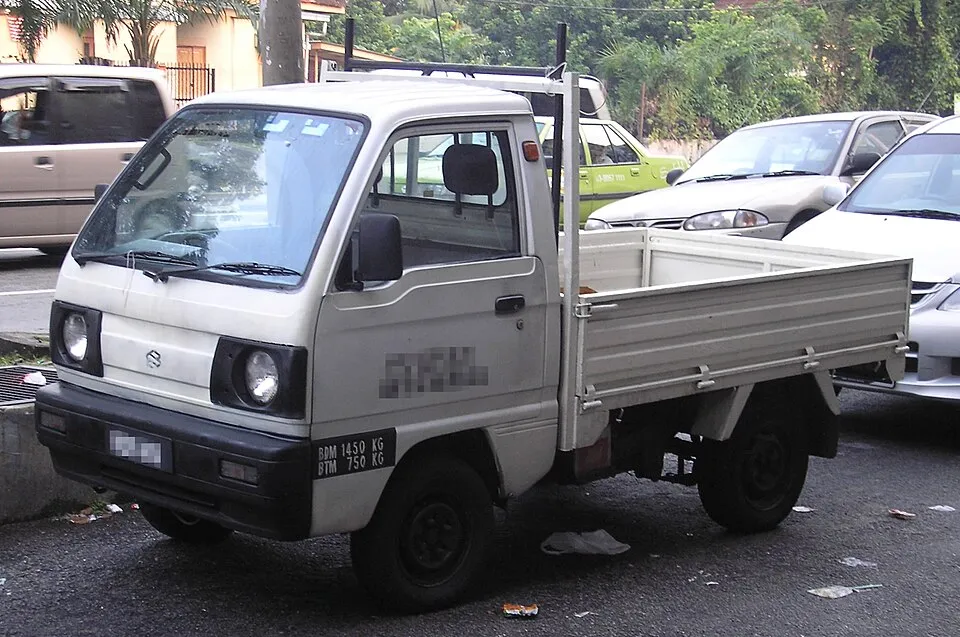
The pickup variant of the fifth generation Suzuki Carry is an example of a cab-forward pickup kei truck.
A cab-forward pickup is derived from a cab-forward van; a van where the driver sits atop the front axle. The first cab-forward pickup was the Volkswagen Transporter which was introduced in 1952. It had a drop-side bed which aided in loading and unloading. American, British, and Japanese manufacturers followed in the late 1950s and 1960s. American manufacturers adopted this design only later, most notably on the 1956-1965 Jeep Forward Control and the first generation Ford Econoline, Chevrolet Corvair Rampside and Loadside pickups, and Dodge A-100.
While this configuration remains popular for large commercial trucks and buses, it is largely regarded as unsafe in smaller vehicles due to the lack of a crumple zone. In the event of a frontal impact, there is nothing in front of the passenger cabin to absorb the force of impact, thus crushing the entire front of the vehicle, occupants included. There have been many accidents in Europe involving large trucks where the cabin was crushed when rear-ending another truck at high speed in conditions with heavy fog. They remain popular due to unimpeded forward visibility and flexible maneuverability, but have largely fallen into disuse in the United States with the exception of purpose-built school and transit buses, as well as garbage and fire trucks.
The Japanese embraced this design because of its high maneuverability on narrow streets and fields. The smallest ones are 360/550/660 cc Kei trucks based on microvans from Daihatsu, Honda, Mazda, Mitsubishi, Nissan, Subaru and Suzuki where the statutory limitation on length makes a short cab necessary. The British also continued this design on the Ford Transit.